
How People Want to Be Led | Leadership Book by Brendaliz Mak

Coming soon

How People Want to Be Led

Leadership Isn’t What You Intend. It’s What People Experience.

How People Want to Be Led explores leadership from the place where it matters most: the experience it creates. Through lived workplace stories, organizational insight, leadership research, and the Led Experience™ approach, Brendaliz Mak examines what builds trust, what quietly destroys it, what happens when people stop speaking, and what leaders and organizations can do differently.

It looks at what happens when leadership intent and employee experience do not match, and what leaders, employees, and organizations can learn from that gap.

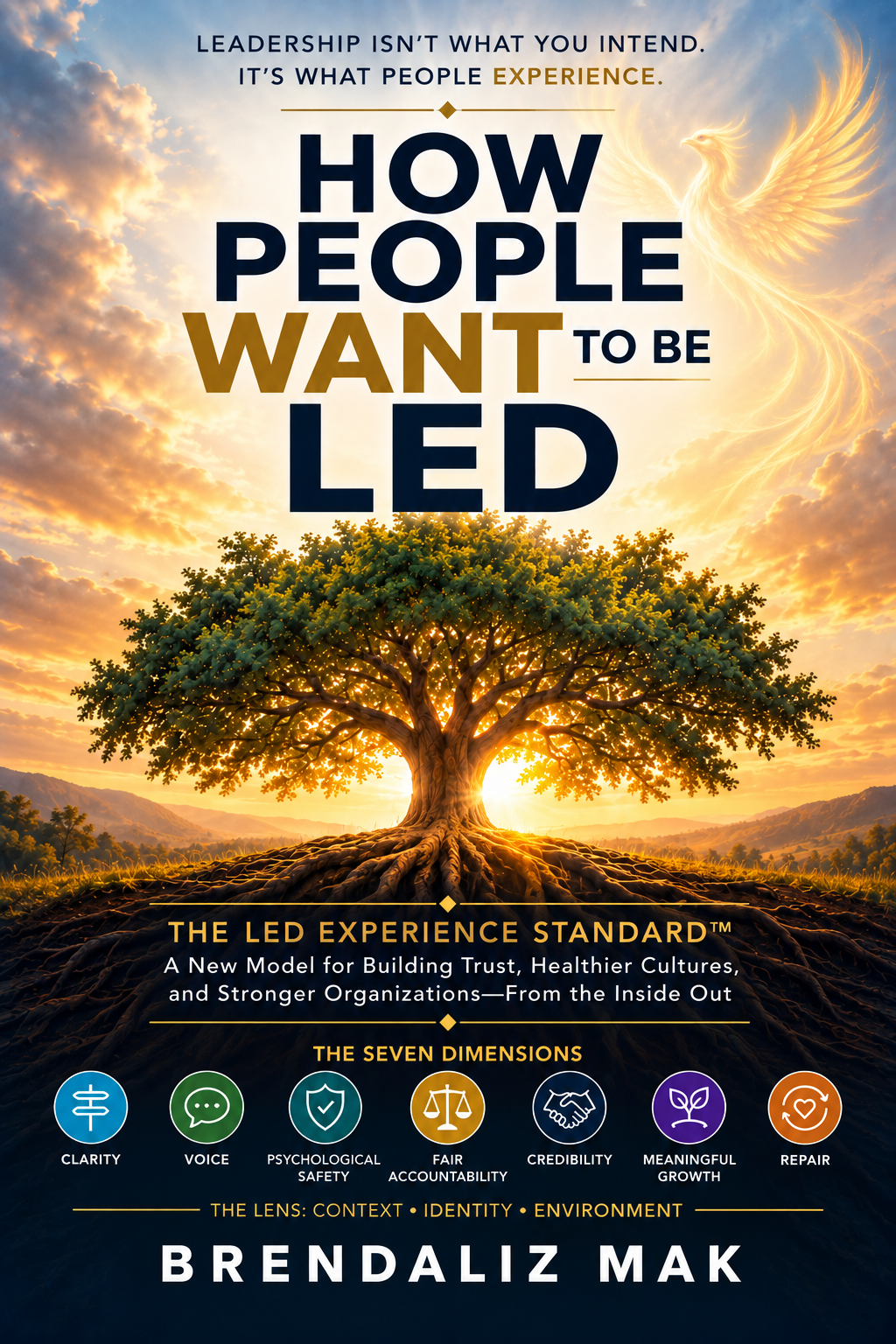
Book cover for How People Want to Be Led by Brendaliz Mak
Coming soonBy Brendaliz Mak

The question many people carry

What If You’re Not the Problem?

Many people spend months, sometimes years, inside workplaces where something feels hard to name. Over time the questions can turn inward, and abilities once trusted begin to feel uncertain.

This is not a diagnosis of you or of any workplace. It is an invitation to consider that workplace systems and leadership experiences can influence how people see themselves.

  • Why am I suddenly questioning abilities I once trusted?
  • Why does speaking up feel dangerous?
  • Why does nothing seem to change when people raise concerns?
  • Why am I exhausted before the workday even begins?
  • Why does accountability seem different depending on who is involved?
  • Why do I keep wondering whether I am the problem?
  • Why am I afraid to leave?
  • Why am I afraid the next workplace could be exactly the same?

Sometimes clarity begins when we stop asking only, “What’s wrong with me?” and begin asking, “What am I experiencing?”

The other side of the question

And What If You Don’t Know What People Experience Around You?

What a leader may intend to be

  • Fair
  • Accessible
  • Supportive
  • Accountable
  • Transparent
  • Direct

What employees may experience

Something different.

Not because anyone is acting in bad faith, but because intention and experience are two different things.

The book does not portray leaders as villains. It makes room for the realities of leading: blind spots, competing pressures, imperfect systems, organizational constraints, unintended impact, growth, accountability, and repair.

Leaders can cause harm without malicious intent.

That is why the challenge is not simply deciding whether a leader meant well. Meaning well matters, but it is not the same as being experienced well.

The deeper leadership question is one that intention alone cannot answer:

What did people repeatedly experience?

Two sides of one experience

One Leadership Experience. Two Vantage Points.

The book is written for the people who lead and the people being led. These are not opposing teams. They are two perspectives within the same leadership experience, and each sees something the other may not.

If you lead

What Are People Experiencing Because of the Way You Lead?

The book helps leaders examine, and ask better questions about:

  • Clarity
  • Employee voice
  • Psychological Safety
  • Fair Accountability
  • Credibility
  • Meaningful Growth
  • Repair
  • Trust
  • Leadership blind spots
  • Organizational conditions
  • Intention and impact
  • What happens when people stop speaking
  • What meaningful repair looks like

Explore Leadership Coaching

If you are being led

What Are You Experiencing—and What Can You Do With What You Now Understand?

The book helps employees consider:

  • Workplace patterns
  • Self-doubt
  • Silence
  • Boundaries
  • Accountability
  • Difficult leadership
  • Confidence
  • Professional support
  • Career decisions
  • Rebuilding self-trust
  • Discerning what comes next
  • Leaving without letting the previous workplace decide the next chapter

Explore Elite Myth Reclaim™

When silence looks like stability

A Quiet Workplace Is Not Necessarily a Healthy Workplace.

What leaders may read in silence

  • Agreement
  • Engagement
  • Satisfaction
  • Stability
  • The absence of problems

Why people may become quiet

  • Earlier concerns went nowhere
  • They do not believe speaking will change anything
  • Speaking feels risky
  • They have learned which issues are safe to raise
  • They are conserving their energy
  • Trust has declined

Silence is not the absence of feedback. Silence is feedback.

That does not mean every quiet team is in trouble. Silence has many possible meanings. The point is for leaders to get curious about what it may mean, instead of assuming they already know.

When organizations treat the effect as the problem

Organizations Often Mistake the Effects of a Problem for the Problem Itself.

An organization may notice performance decline, disengagement, absenteeism, conflict, reduced participation, withdrawal, or turnover, and respond to what it can see without examining what happened beforehand.

Sometimes leaders move quickly toward performance management or discipline without asking whether a known workplace experience contributed to the change. Some performance concerns are exactly what they appear to be, and they deserve a direct response. The question is whether anyone has asked what came first.

The book is not against accountability. It argues for accountability that works.

Accountability should help organizations understand and address the problem—not simply document its effects.

Discipline addresses behavior. Repair addresses damage.

What organizations often notice

  • Performance decline
  • Disengagement
  • Absenteeism
  • Conflict
  • Reduced participation
  • Withdrawal
  • Turnover
Often examined lessWhat happened beforehand?
Diagram: effects organizations often notice, such as performance decline, disengagement, absenteeism, conflict, reduced participation, withdrawal, and turnover, point back to a question that is often examined less: what happened beforehand?

The cost of protecting performance at any price

What Does “High Performance” Really Mean?

A person is not truly a high performer if the organization must continually absorb the damage their behavior creates for everyone around them.

Performance should be measured not only by what a person produces, but by what their presence makes possible—or impossible—for others.

Many organizations face this dilemma. A person produces strong results, and the organization hesitates to look closely at how those results are produced. The cost does not disappear. It tends to be absorbed by others, in extra work, in silence, in workarounds, in lost confidence, and sometimes in departures.

This is not a label for any person, and the book does not diagnose behavior or make legal judgments. It asks leaders to consider outcomes together with the conditions under which they are produced, and to count what a person’s presence makes possible, or impossible, for the people around them.

Legal compliance is not the same as leadership

The Law Establishes the Floor. Leadership Determines the Standard.

Behavior does not have to violate a law before leaders should care about its impact. Even when conduct clears the legal bar, organizations still have to consider dignity, trust, credibility, employee experience, their stated values, workplace expectations, appropriate accountability, and repair.

Compliance asks what is required. Leadership asks what kind of workplace is being built.

This page is not legal advice, and Elite Myth does not determine whether conduct is lawful. Legal and compliance questions belong with qualified legal and HR professionals.

The standard What leaders choose to build
  • Dignity
  • Trust
  • Credibility
  • Employee experience
  • Organizational values
  • Workplace expectations
  • Appropriate accountability
  • Repair
The floorWhat the law and compliance require
Diagram: a narrow base labelled the floor, representing what the law and compliance require, with a larger area above labelled the standard, representing what leaders choose to build.

What happens when we leave

Sometimes We Leave the Workplace Before the Workplace Leaves Us.

Leaving a difficult workplace does not always mean leaving the experience behind. Fear can travel forward. Difficult workplace experiences can shape what we expect from the next one, and the questions that come with us can be hard to set down.

  • What if the next workplace is just as bad?
  • What if I leave and regret it?
  • What if the next manager is the same?
  • What if I do not recognize the warning signs?
  • What if every workplace is like this?
  • What if the problem really was me?
  1. It can begin asDo I want this job?
  2. Then becomeWill I be safe here?
  3. And eventuallyCan I trust myself to know the difference?

This is not a description of any medical or psychological condition. It is a recognition that difficult experiences can influence how we approach what comes next.

The goal is not certainty about the next workplace. The goal is greater trust in ourselves.

Fear-based vigilance

  • Scans every interaction for danger
  • Reads ambiguity as confirmation
  • Decides from what we fear

Informed discernment

  • Notices patterns over time
  • Asks better questions and weighs what it learns
  • Decides from what we value

The goal is not finding a perfect employer. It is becoming better equipped to:

  • Recognize patterns
  • Ask better questions
  • Understand boundaries
  • Evaluate leadership behavior
  • Distinguish conflict from dysfunction
  • Recognize whether repair is possible
  • Respond intentionally
  • Make choices without abandoning oneself

For readers who want a coach alongside them while they work through this, Elite Myth Reclaim™ exists for that purpose. The book stands on its own.

Imperfect does not mean unhealthy

Healthy Doesn’t Mean Perfect.

Healthy organizations still experience conflict. Leaders make mistakes, and so do employees. Communication breaks down, difficult decisions get made, and accountability can be uncomfortable.

The book is not an invitation to label every hard interaction as something larger. The question that often tells the difference is:

What happens after something goes wrong?

A healthier system is capable of

  1. Listening
  2. Acknowledging
  3. Learning
  4. Correcting
  5. Holding people accountable
  6. Rebuilding credibility
  7. Changing behavior
  8. Repairing trust where possible

Repair is not a meeting. Repair is a process.

The Led Experience™ behind the book

From Experience to a Standard.

The book grows out of a structured way of understanding leadership experience. The Led Experience Standard™ gives leaders and organizations a shared language for what people experience through leadership, and for the circumstances around it. Here is the shape of it, without repeating the Standard itself.

Seven Dimensions

What people experience through leadership.

  • Clarity
  • Voice
  • Psychological Safety
  • Fair Accountability
  • Credibility
  • Meaningful Growth
  • Repair

Four Conditions

The circumstances that can support or undermine the experience.

  • Dignity
  • Boundaries
  • Capacity
  • Systems

Trust

The cumulative outcome of repeated leadership experience. Understood separately, and not an eighth Dimension.

Context, Identity & Environment Lens™

A reminder that context, identity, culture, and environment influence how leadership is experienced and interpreted. It is a lens for interpretation, not a scored Dimension or Condition.

The Led Experience™ is a proprietary developmental framework. It is not presented as psychometrically validated. For organizations that want to apply these ideas beyond individual leaders, see Organizational Health.

Explore the Led Experience Standard™Explore the Led Experience™

What readers will explore

Ideas to Sit With, Not a Checklist to Follow.

These are some of the themes the book invites readers into. It is a window into the book, not a summary of it.

  • 01

    Leadership Experience

    Why intention alone does not determine leadership effectiveness.

  • 02

    Voice & Silence

    What leaders can learn from what employees say, and from what they stop saying.

  • 03

    Psychological Safety

    What happens when speaking honestly begins to feel risky.

  • 04

    Fair Accountability

    Why accountability must examine both behavior and context.

  • 05

    Credibility

    What happens when organizational actions contradict organizational values.

  • 06

    Repair

    Why apology, discipline, and repair are not the same thing.

  • 07

    Organizational Patterns

    How recurring experiences can reveal something larger than an isolated incident.

  • 08

    Self-Trust

    How difficult workplace experiences can change the way people see themselves, and how confidence can be rebuilt.

  • 09

    What Comes Next

    How leaders, employees, and organizations can make different choices once they understand what they are experiencing.

From understanding to action

Recognizing a Problem Is Only the Beginning.

The book’s practical movement is from understanding to action. The 90-Day Led Experience™ Leadership Reset is part of that movement, not a separate book, and it helps move the leadership conversation toward change that can be observed and sustained.

Explore Leadership Coaching

  1. Reflection
  2. Priority setting
  3. Behavioral change
  4. Difficult leadership situations
  5. Systems
  6. Trust
  7. Accountability
  8. Reassessment
  9. Sustainment
Portrait of Brendaliz Mak, author of How People Want to Be Led and creator of the Led Experience Standard™

About the author

Why Brendaliz Mak Is Writing This Book.

For more than twenty years, Brendaliz Mak has worked inside complex organizations across the public sector, human resources, organizational operations, public safety, governance, nonprofit leadership, and education, observing both effective leadership and organizational dysfunction firsthand. She has also served as a university instructor and holds graduate education in management and organizational behavior.

Across those settings, one question kept returning: what is it actually like to be led here? How People Want to Be Led brings together that experience, her leadership lessons, and the Led Experience™ approach to help leaders see what their leadership creates, and to help people inside difficult workplaces make sense of what they are experiencing.

About BrendalizInvite Brendaliz to speak

Book status In development

Be Part of What Comes Next.

How People Want to Be Led is currently being developed. No release date has been announced, and the book is not yet available.

Join the updates list to hear as things take shape.

What to expect

  • Book updates
  • Release information
  • New Elite Myth insights
  • Speaking updates, where appropriate

Get Book UpdatesExplore Elite Myth Insights

How People Want to Be Led

Leadership Changes When We Start Paying Attention to Experience.

Whether you are trying to understand the experience you create as a leader, the experience you are living as an employee, or the culture taking shape inside an organization, the first step is learning to see what is actually happening.